Evaluating Stop Alert or Warning Signs 3D Rendering for Professional Design Workflows
In the realm of digital graphic design and safety communication, the visual impact of a warning sign can determine whether a message is noticed, understood, and acted upon. As designers move away from flat, two-dimensional graphics toward more immersive and realistic presentations, Stop Alert or Warning Signs 3d Rendering has emerged as a critical resource. This approach involves using high-fidelity three-dimensional models to depict safety signage, offering a level of depth, lighting realism, and material texture that traditional vector illustrations often lack. For professionals tasked with creating mockups, safety manuals, or marketing materials for industrial products, understanding the utility and limitations of these assets is essential for making informed decisions about their design toolkit.
Understanding the Distinct Value of 3D Rendered Assets
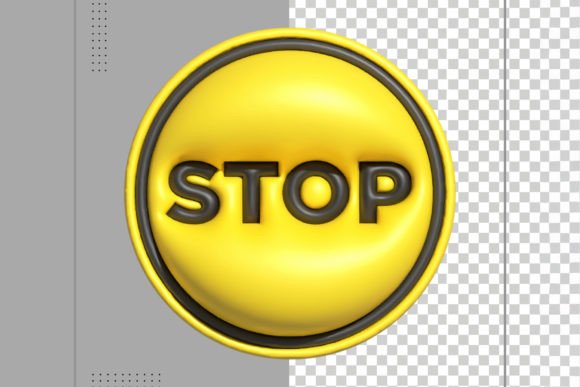
The primary distinction of Stop Alert or Warning Signs 3d rendering of alert isolated on a transparent background lies in its versatility and visual fidelity. Unlike standard stock photos, which are bound by the specific lighting and angles of the original photograph, 3D rendered assets are constructed digitally. This allows for precise control over every visual element. When a designer utilizes a high-quality 3D render, they are not just inserting an image; they are integrating a object that behaves like a physical entity within a digital space.
One of the most significant advantages highlighted in premium templates is the resolution and clarity. With specifications such as High-Quality 3D Rendering Object Resolution 4500 x 3000 with 300 DPI, these files are print-ready. This is a crucial differentiator for professionals who need to scale images for large-format printing, such as billboards, trade show banners, or detailed technical documentation, without experiencing pixelation or loss of sharpness. The transparency of the background further enhances usability, allowing the sign to be placed over any context—whether it is a construction site photo, a clean white brochure page, or a complex website interface—without requiring tedious manual cutouts.
Comparing 3D Renders to Traditional Design Alternatives
When evaluating resources for safety signage, designers typically choose between three main categories: flat vector icons, photographic stock images, and 3D rendered objects. Each serves a different purpose, and recognizing where Stop Alert or Warning Signs 3d Rendering fits is key to efficient workflow management.
- Flat Vector Icons: These are ideal for user interfaces, apps, and minimalist web design where scalability and small file sizes are prioritized. However, they lack the tactile realism needed to convey urgency or physical presence in marketing materials.
- Photographic Stock Images: While realistic, photos are often limited by their environment. A photo of a stop sign taken in bright sunlight may not match the moody, low-light aesthetic of a corporate presentation. Additionally, removing backgrounds from complex photos can result in jagged edges or halos.
- 3D Rendered Objects: This category bridges the gap. It offers the realism of photography but with the flexibility of vectors. The ability to manipulate lighting, angle, and texture makes it superior for custom branding projects where consistency is paramount.
The tradeoff with 3D renders is typically the initial learning curve associated with editing software. However, modern templates have mitigated this barrier significantly. By utilizing Smart Object Replacement Layers, designers can bypass complex 3D modeling software entirely. The workflow is streamlined: users open the file, double-click the smart object layer, paste their own design or text, save, and the changes automatically reflect on the 3D model. This "very easy to use" approach ensures that even designers with minimal 3D experience can achieve professional results with just a few clicks.
Practical Applications and Best-Fit Scenarios
Determining when to use Stop Alert or Warning Signs 3d Rendering depends largely on the project's goals. These assets are particularly effective in scenarios where realism influences perception. For example, in industrial safety training manuals, a 3D rendered warning sign can look more authoritative and tangible than a cartoonish icon, potentially increasing compliance and attention to detail among workers.
Another strong use case is in product packaging and advertising. If a company sells safety equipment, such as helmets, vests, or barriers, incorporating a 3D rendered warning sign into the promotional material creates a cohesive visual narrative. The high resolution ensures that the textures of the sign—such as the reflective quality of the red paint or the metallic sheen of the post—are visible and convincing. This level of detail helps build trust with the consumer, suggesting that the physical product will match the high quality of the advertisement.
Furthermore, the organizational structure of these files plays a vital role in professional efficiency. Templates that feature very Organized File included PSD and jpg formats allow for seamless integration into existing workflows. The inclusion of both PSD (Photoshop Document) and JPG formats ensures compatibility across different stages of production. The PSD allows for deep customization, while the JPG provides a quick-to-use asset for rapid prototyping or digital-only applications where editing is not required.
Limitations and Decision Factors
While Stop Alert or Warning Signs 3d Rendering offers numerous benefits, it is not a universal solution for every design challenge. Designers must consider the following limitations before committing to this format:
- File Size and Performance: High-resolution files at 300 DPI are large. For web-based projects where loading speed is critical, these assets may need to be compressed significantly, which could negate some of the visual benefits. In such cases, optimized SVGs or lower-resolution PNGs might be more appropriate.
- Stylistic Consistency: If a brand’s visual identity is strictly minimalist or flat, introducing hyper-realistic 3D elements can create visual dissonance. It is important to ensure that the 3D render complements the overall design language rather than clashing with it.
- Customization Constraints: Although smart objects make editing easier, they are not infinite in their flexibility. Changing the fundamental shape of the sign or the perspective of the camera angle may require returning to the original 3D modeling software, which is beyond the scope of standard Photoshop editing. Users should verify that the provided angles and shapes meet their specific needs before purchase.
It is also important to note that All images that are not included are examples for presentation purposes only. This means that while the template provides the structure and the 3D model, the specific graphics, logos, or text displayed in previews are placeholders. Designers must be prepared to input their own content. The ease of editing—described as 100 very easy to edit, just double-click on the smart object, edit, and save—relies on the user having the necessary content ready to go.
Making the Right Choice for Your Project
Ultimately, the decision to utilize Stop Alert or Warning Signs 3d Rendering should be driven by the need for realism, flexibility, and high-quality output. For professionals who frequently create mockups, safety documentation, or high-end marketing collateral, the investment in such templates pays off through time savings and enhanced visual credibility. The ability to change colors easily and replace content via smart objects transforms a static image into a dynamic tool that can adapt to various client needs.
However, for simple web icons or quick internal memos, simpler formats may suffice. The key is to match the tool to the task. By understanding the strengths of 3D rendering—such as its depth, lighting control, and print-ready resolution—designers can strategically deploy these assets to elevate their work. When used correctly, these renders do more than just display a warning; they command attention and convey professionalism, ensuring that the message is not only seen but respected.
As you explore your options, consider reviewing the specific features of the template, such as the organization of layers and the resolution specs. A well-structured file can save hours of frustration, allowing you to focus on creativity rather than technical troubleshooting. Whether you are updating a safety manual or designing a new ad campaign, integrating high-quality 3D elements can provide the competitive edge needed in today’s visually saturated market.